
The Gaze That Turns Us to Stone: Caravaggio’s Medusa in the Age of the Screen
P. N. Chen on 30th Sep 2026
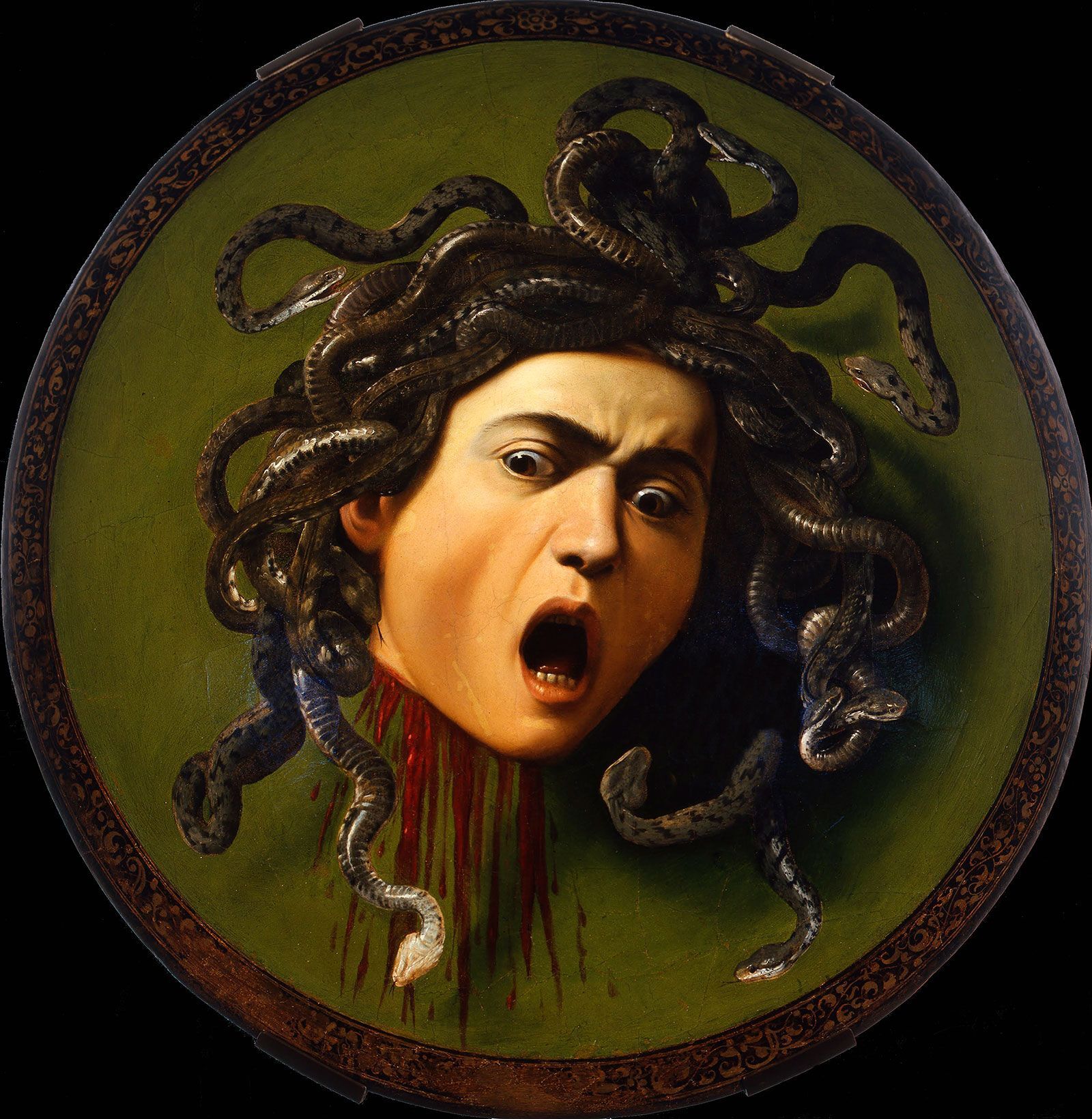
There are faces that refuse to stay in the museum. Caravaggio’s The Head of Medusa - oil on canvas stretched over a convex wooden parade shield, now in the Uffizi Gallery, a museum in Florence - does not hang politely. It presses forward. The mouth opens on a scream that never finishes. The snakes writhe as if the air itself were still dangerous. You do not so much look at her as negotiate with a look that was designed, centuries before the feed, to arrest the body.
That is the old power of the gorgoneion: the image that wards by terrifying. And it is, uncannily, the new power of the screen - the surface that holds your attention until something in you goes still.
The shield that looks back
Caravaggio did not invent Medusa. He reinvented the support. Instead of a flat panel pretending to be a window, he painted on a rotella - a round, convex parade shield, or scudo da parata - whose curve makes the head seem to surge toward you as you walk past. The object remembers the myth’s hardware: Perseus’s mirrored defense and Athena’s aegis, where the gorgon’s face becomes protective armor. It also taps the older logic of the gorgoneion, the frontal Gorgon mask used as an apotropaic image: a face that wards off harm by displaying the very terror it promises to repel.
Stand before it and the geometry does the psychological work. Convexity is not a gimmick; it is a thesis. Reflection, weapon, and portrait collapse into one disk. The painting is less a picture of a myth than a machine for thinking about how looking can wound - and how looking, carefully angled, can save.
The mirror as a technology of distance
In Hesiod’s Theogony, the genealogy is comparatively spare: Medusa is the one mortal Gorgon among three sisters, and the emphasis falls on the dangerous creature Perseus must overcome. Ovid, writing centuries later in the Metamorphoses, supplies the more psychologically charged prehistory: Medusa was beautiful, and after Neptune violated her in Athena’s temple, the goddess transformed her hair into snakes. These are not interchangeable versions of one settled script. They give later artists different Medusas to inherit - monstrous from birth, or made monstrous through punishment and the politics of narration.
In both traditions, Perseus prevails not by staring harder but by refusing the direct look: he reads her in a polished shield, then severs the head. Even afterward, the trophy remains lethal - mounted, carried, flashed as power. The gorgoneion turns that lethal remainder into an apotropaic sign, and Athena’s aegis makes the paradox explicit: the face that petrifies becomes armor. Caravaggio skips the long preamble. He gives you the cut already made - the head still vivid with the shock of its own ending.
Why the Medici wanted a gorgon on a parade shield
Cardinal Francesco Maria del Monte - Caravaggio’s early protector in Rome and a diplomatic agent for Medici interests - is the hinge in the Uffizi shield’s documented journey. The rotella was commissioned through del Monte and offered to Grand Duke Ferdinando I de’ Medici in 1598, with the delivery recorded on 25 July; its usual art-historical dating, around 1597-98, keeps the making and the gift in view without pretending to a more exact studio chronology. The gift logic is courtly and sharp: a gorgon on a shield flatters a ruler’s courage against enemies while staging the dynasty inside a myth of invincible looking. Iconographically, Medusa had long served as an emblem of force that petrifies opposition. For the Medici, this was not obscure symbolism. It was dynastic image-making conducted through the language of antiquity.
Caravaggio paints the instant between life and death
What startles, even now, is the timing. This is not Medusa as heraldic logo. It is Medusa mid-catastrophe - eyes wide, brows knotted, blood implied, serpents thrashing in every direction. Caravaggio’s realism does not soften the myth; it makes the myth physiologically credible. Horror becomes a facial event. Death becomes a facial event. The Baroque lesson lands hard: sacred and secular alike can be lit like a street fight.
Two Medusas, one obsession
The Caravaggio record is often narrated through two works: an earlier image called the Medusa Murtola, after the poet Gaspare Murtola’s response to it, and the celebrated Uffizi Medusa. But the relationship between the two, their precise dating, and even the neatness of calling both surviving "shields" are not matters to flatten into certainty. What can be said more securely is that the Uffizi work is a painted canvas mounted on a convex wooden rotella, generally dated around 1597-98, and that it entered the Medici orbit as a gift associated with del Monte and Ferdinando I.
That caution does not weaken the artistic story. Young Caravaggio keeps returning to a face that is also a weapon, a trophy, and a trap for the eye.
Before and after the rotella
Caravaggio’s shield also belongs to a sequence rather than a solitary breakthrough. Benvenuto Cellini’s bronze Perseus with the Head of Medusa, made for Florence in the 1540s and 1550s, already turned the myth into Medici political theater before Caravaggio painted his rotella. And the often-repeated Renaissance prehistory involving Leonardo should be handled as legend: Vasari described a now-lost Leonardo Medusa shield, but there is no surviving object and no firm basis for claiming that del Monte instructed Caravaggio to imitate it.
Self-portrait as petrifying other
A durable scholarly intuition - supported by the period’s mirror practice and by Caravaggio’s taste for inserting his own features into extremes - holds that he studied his reflection to build Medusa’s face. If so, the painting is a double bind of rare elegance: the artist becomes the monster whose look he must not meet too directly; the viewer inherits Perseus’s problem with none of Perseus’s distance. We stand where the hero stood, except the shield is already painted, and the reflection is already a scream.
The modern screen as a new reflective surface
Here is where the seventeenth century leans into the twenty-first without needing a lecture.
We live inside portable shields. Phones, laptops, glass storefronts, black mirrors in darkened rooms: surfaces that show us ourselves while promising to show us the world. The feed is a gorgon with infinite heads. Look too long, too straight, too hungry, and something softens into stone - attention calcifies, empathy cools, the self hardens around its own performance.
Medusa also survives here as design rather than Pop art. When Versace adopted a Medusa emblem in 1993, the house drew on classical form and the circular logic of a coin or shield: a memorable identity built from Mediterranean antiquity, not a claim that the logo itself belongs to the Pop canon. Its afterlife shows how efficiently the gorgoneion can move from protective sign to cultural signature.
Caravaggio’s insight, read through a contemporary lens, is not "screens are bad." It is subtler, and more useful: the danger is unmediated ego. Medusa, in this reading, is the mind that cannot stop staring at its own power - the self that petrifies others because it has already petrified itself. Perseus’s mirror is technique: a way to see without being seized. Athena’s shield is integration: danger metabolized into wisdom’s armor.
Read this way, the tyrant is less a person than the grip of identification itself. As that grip loosens, the gaze changes hands. Looking becomes meditative rather than predatory; the viewer, rather than the image, holds awareness.
Contemporary response - the Neoclassical Pop Art Medusa series
The contemporary works reproduced here are part of PriYa N. Chen’s ongoing Neoclassical Pop Art Medusa series, which reinterprets classical imagery through contemporary material and digital culture. That is the quiet hinge of the cycle: classics meet code, myth meets the interface, and the old question returns with Wi-Fi - Who is looking, and who is being turned to stone?
Medusa by the Seashore shifts the myth away from the severed head and toward embodied agency. Storm light, crashing waves, and a glowing star reframe the Gorgon as an empowered presence rather than a trophy of conquest. Animation gives the ancient gaze room to breathe - a digital afterlife of Caravaggio’s chiaroscuro that keeps the problem of looking alive without freezing it into a museum instant.
That same afterlife appears in sculptural form in Medusa’s Tresses: classical marble, pedestal, and mythic poise meet the playful pop materiality of balloon-tube hair. The ancient gorgon becomes both sculpture and cultural remix, without losing her charged gaze.
Caravaggio’s afterlife is equally material across centuries. Rubens’s Head of Medusa turns the severed face toward a later, more baroque naturalism; Bernini’s marble Medusa compresses the myth into a sculptural encounter; Canova’s Perseus with the Head of Medusa recasts the hero in the lucid finish of Neoclassicism. Across those works, the gorgon keeps changing temperature while preserving the same problem: how can an image of danger be made to face us?
In the flame acrylic works, that problem is restated in heat and chroma - the historical shield translated into a luminous contemporary plane.

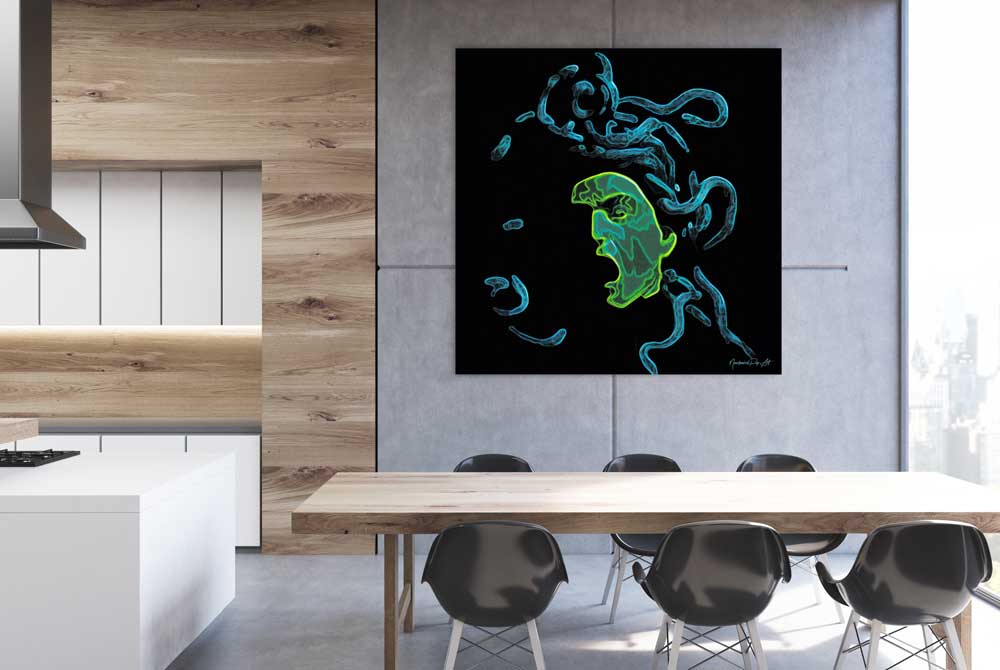
In the Blue Medusa series, the historical shield is translated into another reflective contemporary surface: acrylic. Its cool luminosity places the Gorgon closer to the visual language of screens, glass and illuminated interfaces. Printed on acrylic, the image acquires a reflective depth that recalls the screen while departing from Caravaggio’s painted wooden shield. The acrylic edition remembers the screen’s cool glow - and answers it with an object whose material presence resists the weightlessness of the feed.
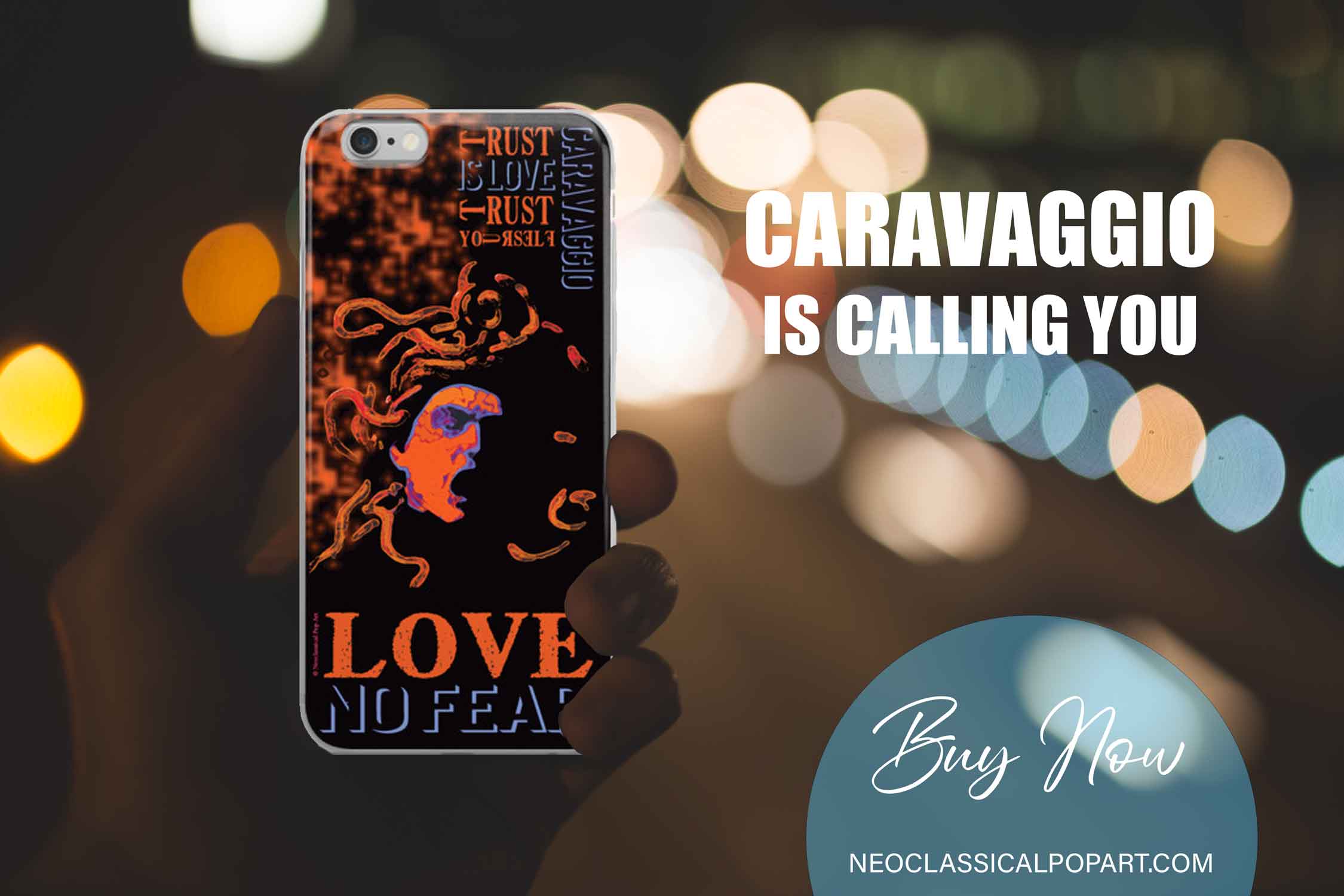
The migration of Medusa onto a phone case creates an almost literal return of the gorgoneion to the shield: the protective face now surrounds the object through which contemporary identity is reflected, performed and circulated.
Looking without turning to stone
We do not need to defeat the Gorgon by violence. We need Perseus’s craft and Athena’s composure: angled seeing, integrated courage, a gaze capable of meeting the image without surrendering the self.
In an age of endless surfaces, that is less a museum footnote than a daily practice.
The mirror is yours to hold.
Works from the Medusa Series
Explore the contemporary works discussed in this essay.