

ComfyUI Makes the Image Pipeline Visible
Priya N. Chen on 6th Nov 2026

ComfyUI Makes the Image Pipeline Visible
I trust an image process more when I can see where each decision enters. ComfyUI turns text-to-image generation into a connected node graph: a prompt goes in, a trained diffusion model supplies learned patterns, and a sampler works through latent space before the result appears as pixels. The graph shows the route. It does not show what images trained the model, or who gets credit for the image.
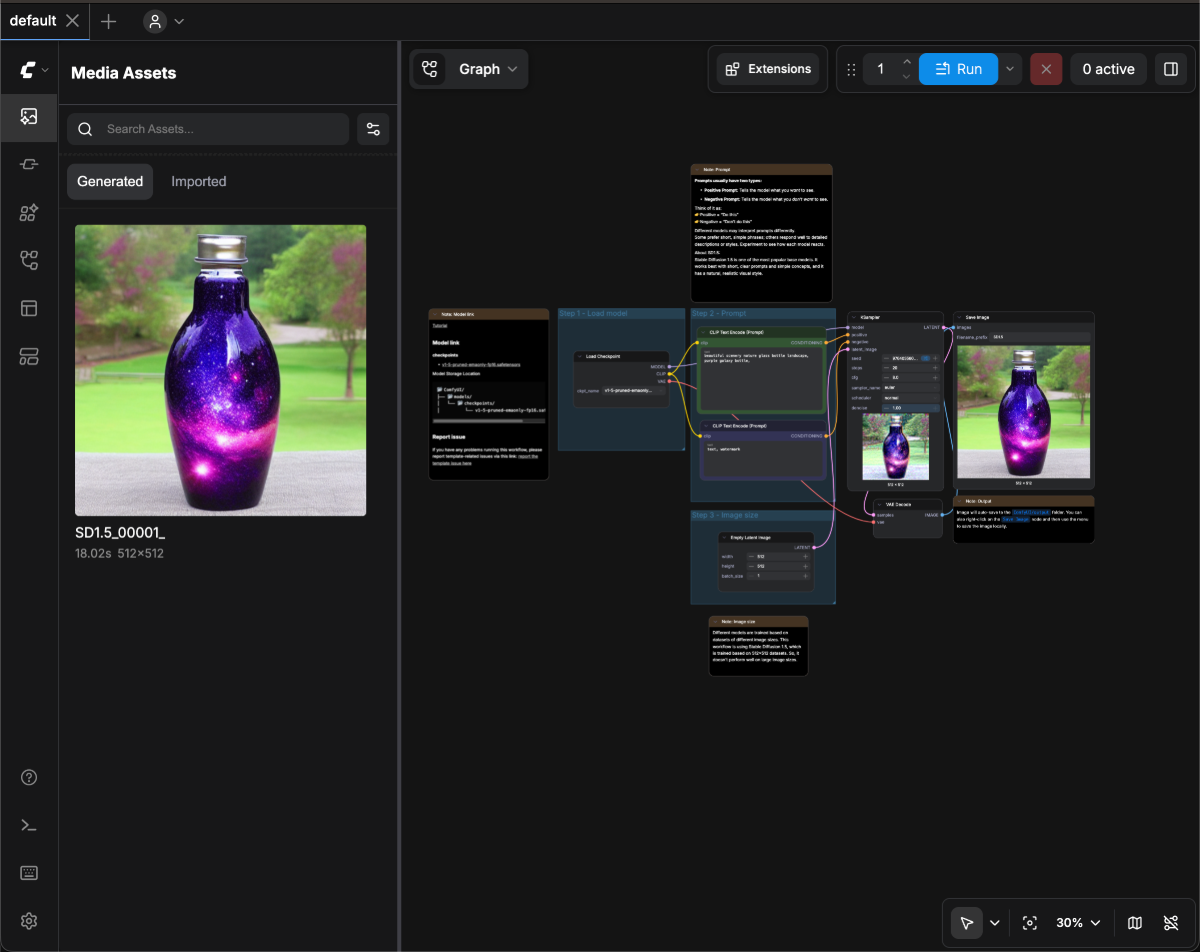
The documented workflow starts with the SD1.5 checkpoint v1-5-pruned-emaonly-fp16.safetensors, placed in ComfyUI/models/checkpoints. Load the example workflow, select the checkpoint in the Load Checkpoint node, then edit positive and negative prompts in the CLIP Text Encoder. The KSampler runs the process; Save Image displays the result. Click Queue or press Ctrl+Enter. The graph is useful because each stage has a place to inspect and revise.
ComfyUI is open source. Local use is free, but the artist supplies a GPU. Comfy Cloud offers five free GPU runs for new users and 400 free credits each month after Google sign-in. Its paid plans include Standard at $16 a month billed yearly and Team at $630 a month billed yearly. Locally, the user pays for hardware; in Cloud, the user pays Comfy for access. The workflow documentation does not establish who owns generated images or set terms for their use. It also does not establish the example model’s training sources or consent and credit policies. That gap matters: Kate Crawford’s focus on labor and training data points to the people whose work may shape a model, including artists and data labelers. Andrew Ng’s optimism about access and education speaks to the other side: a visible, editable pipeline can give more makers room to experiment.
Is AI a tool in the hand of the artist, as the camera and the brush were, or something else? ComfyUI makes direction more tangible, but a graph cannot answer who owns the system or whose work went into its training. The fear is lost commissions, training without consent or payment, work flattened into style, and power gathering in a few firms. The hope is more people gaining practical control over image-making. Copyright requires a human author. An AI system cannot be an author or register copyright in its own output. The D.C. Circuit held this in Thaler v. Perlmutter, 130 F.4th 1039 (March 2025); the Supreme Court denied review on 2 March 2026. The Copyright Office registers only works with human authorship. AI-assisted work can be protected where a human contributed authorship; courts have not said how much direction, selection, iteration, and editing is enough. The open question is whether the company that owns the system or the user who directs it is the human author of a given work. ComfyUI exposes the making. It cannot settle the credit, ownership, or profit.
Join Neoclassical Pop Art daily take on the arts, the weekly letter, and first word on product launches, sales, and free gifts.