
A Shine After the Body: Warhol’s Gold Marilyn Monroe
Priya N. Chen on 29th Oct 2026
Spirituality in Art

A Shine After the Body: Warhol’s Gold Marilyn Monroe
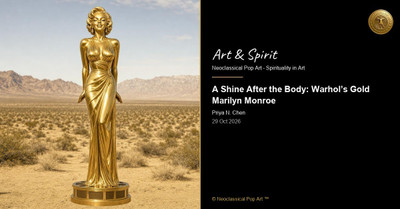
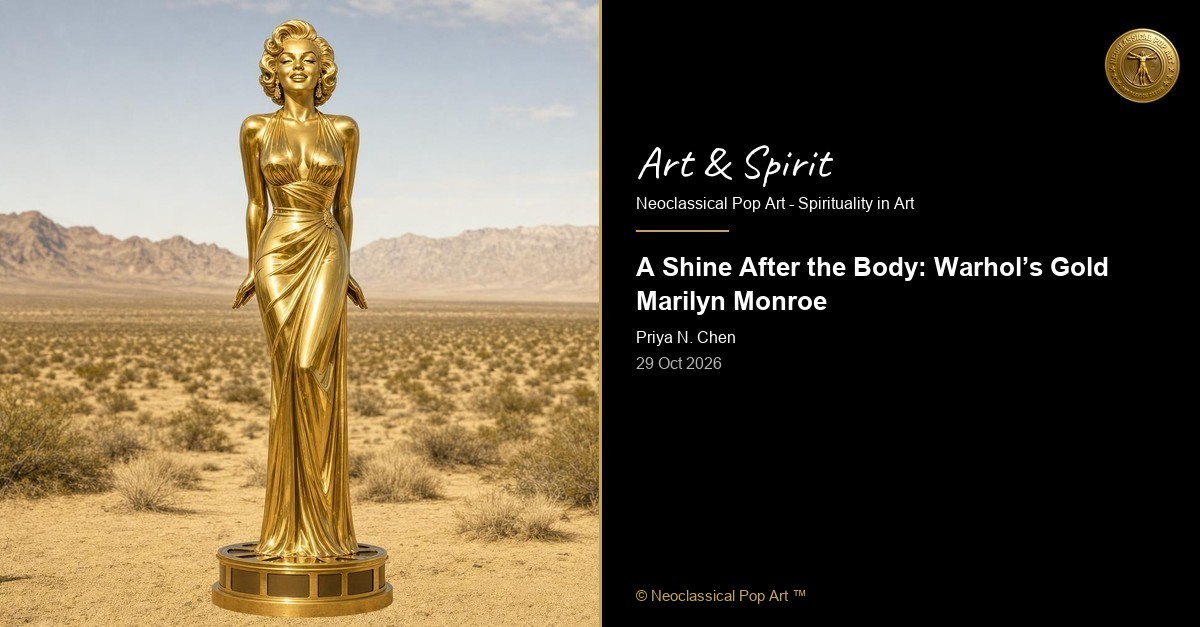
The face is small and set high in a field of gold. Andy Warhol’s Gold Marilyn Monroe, finished in 1962, is at the Museum of Modern Art in New York. He screened a publicity still from Niagara, 1953, onto a canvas he had painted a shiny gold. Marilyn Monroe died that same year.


She had already written a light of her own. “I exist more with the cold glistening frost,” and then, “my beaded rays have the colors I’ve seen in a painting.” Cold, and a picture she had seen. This gold is not that sentence. It holds a face that was already a photograph, lifted clear of any room and any hand. The sacred survives as shine. The person survives as a screen.
Her death is nowhere, and then a thing she can still see. “Oh damn I wish that I were dead — absolutely nonexistent — gone away from here — from everywhere.” She looks for a bridge, and the Brooklyn Bridge stops her: “everything is beautiful from there and the air is so clean.” She ends, “I’ve never seen an ugly bridge.” The wish to be gone meets something beautiful. This gold gives her no bridge. No one kneels. No hand answers.
She refused the death that punishes. She wrote that she will not be “sent to hell to burn with bad people feeling that I am also bad.” In New York in 1955 she wrote, “I haven’t had Faith in Life — meaning Reality,” and that she wanted “to realize the present, whatever it may be.” The present in this picture is the gold. The life is not in it.
Looking at a sleeping face, she wrote, “but will he look like this when he is dead.” The same still returns in Marilyn Diptych, also 1962, at Tate Modern in London: fifty faces, one side bright, the other black and white and failing. He made it shortly after her death. On the right the image wears out by being printed again. Warhol wrote that he does not believe in death, “because you’re not around to know that it’s happened,” and “I can’t say anything about it because I’m not prepared for it.” He was painting the Marilyns when he said, “I realized that everything I was doing must have been Death,” and that “when you see a gruesome picture over and over again, it doesn’t really have any effect.” She stays because a bridge is beautiful. He repeats the face until death has no effect.


We are living inside that perception this evening. The face on your screen is finished before you have finished looking. A filter lays gold over whoever is in the room. Fame is the halo we hand one another, and then we mourn the person the halo left out. What this gold leaves you to sit with is a virtue. The virtue is attention. Attention is the ethic of giving a life what is due to a life, when a shine is easier to love. It is how a person in this century tells an image from a soul. Presence is quieter than the shine. It does not reprint well.
A moment of attention
Look at how little of the gold the face occupies. She wished to be nonexistent, and a bridge held her. He said you are not around to know. In the day you are actually in, what does that attention owe the person who is here?

Join Neoclassical Pop Art daily take on the arts, the weekly letter, and first word on product launches, sales, and free gifts.