
Rembrandt, Now Available in Skin
Priya N. Chen on 4th Nov 2026

Rembrandt, Now Available in Skin
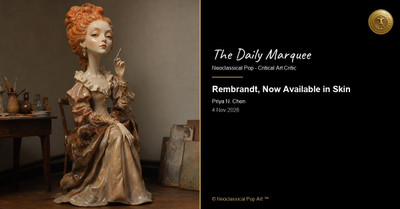
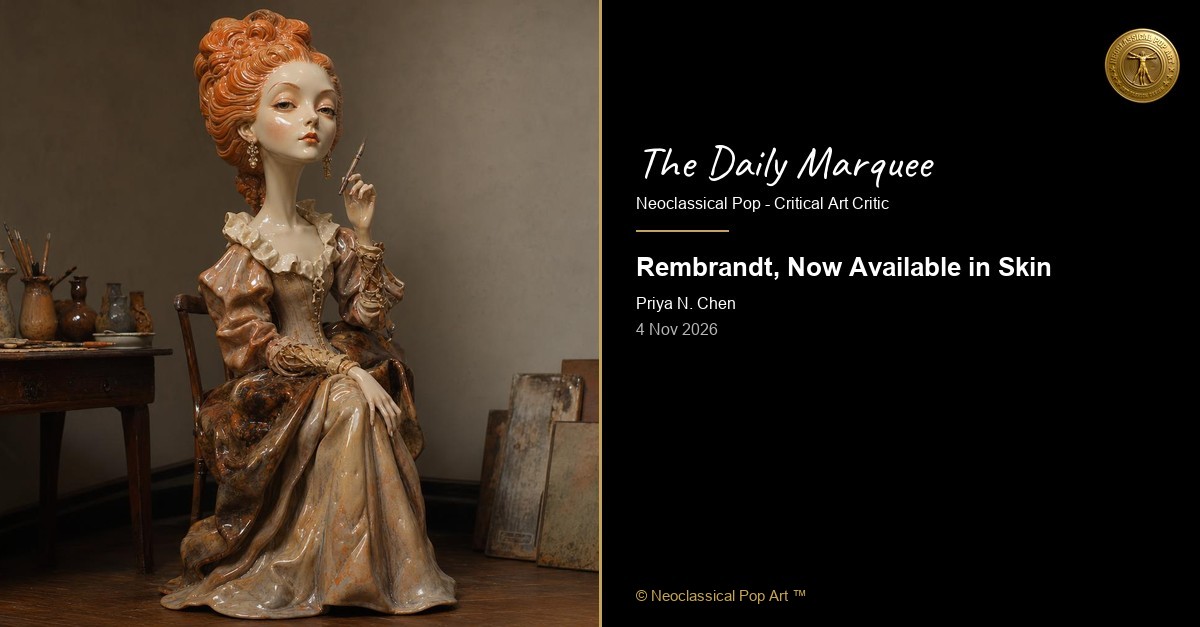
I think a tattoo of a Rembrandt is a bolder souvenir than a Rembrandt tote bag, which at least lets you change your mind by Friday—and a worse way to pretend you own the art. At Amsterdam’s Rembrandt House Museum, a pop-up tattoo studio is putting 17th-century masterpieces on people. Smithsonian Magazine’s 3 November 2026 headline calls it a “Poor Man’s Rembrandt” and asks whether one costs a few hundred dollars. The phrase is funny, but the bargain is not really for a Rembrandt. It is for the feeling of carrying one around.
That feeling has a long history. Portraits once announced who mattered; a painted face could preserve a sitter’s status long after the sitter was gone. Tattoos reverse the arrangement. The image travels on an ordinary body, not a palace wall, and the wearer becomes both audience and display case. There is something democratic in that, and something cheeky: the museum’s masterpiece steps off its pedestal and joins the daily traffic of sleeves, selfies, and summer clothes. But the old hierarchy survives in miniature. The famous image lends its prestige to the person, while the person lends the image a pulse.
The museum is a particularly good—and slightly awkward—place for this exchange. Rembrandt’s house turns the artist’s life into a destination; now the visit can leave a mark that lasts longer than the gift-shop receipt. That is more intimate than a reproduction, but intimacy is not the same as understanding. A tattoo can make art feel close without making it legible. The risk is that the masterpiece becomes a logo: instantly recognizable, endlessly portable, and stripped of the slow looking that made it matter in the first place. Still, art has never been above a little vanity. The painted portrait and the tattoo both ask the same delicious question: how do I want to be seen?
And “Poor Man’s Rembrandt” has a pop-cultural sting. The title recalls Rich Man, Poor Man, the 1976 television drama starring Dorothy McGuire and Ed Asner: a story of social rank compressed into a phrase. Here, the joke turns class into a price tag. A few hundred dollars may buy the image, but not the old privilege of commissioning a master. What it can buy is a new kind of access—personal, public, and impossible to hang straight. That is the real twist: the museum’s art does not become cheap when it enters the skin. It becomes harder to keep at a safe distance.

Your Daily Marquee arrives with the morning coffee: one remarkable event in the art world, and a critic witty enough to zip the coffee with it.
Join Neoclassical Pop Art daily take on the arts, the weekly letter, and first word on product launches, sales, and free gifts.