
Pamela Joyner: Empty Walls, a Purpose
Sri PriYa N. Chen on 7th Nov 2026

Pamela Joyner: Empty Walls, a Purpose
Every week, for as long as she can remember, Pamela Joyner went to the Art Institute of Chicago. She calls it a place of wonder, and she calls the childhood it gave her one spent immersed in the arts. There she stood before Georges Seurat’s A Sunday Afternoon on the Island of La Grande Jatte and imagined herself strolling the riverbank with the figures in the painting. She calls the experience transformational. Even then she noticed how little diversity there was among the artists in museums and the people they painted.
She began collecting a few years after Harvard Business School, for a reason she calls practical: she had empty walls to fill and wanted to be surrounded by beautiful art. In the 1990s she turned her attention to artists of the African diaspora, and found that few experts were around. Books became her experts. She read before she bought, and she tells art lovers that a collection of books is as worthy as a collection of art.
The first artist she came to know well was Richard Mayhew, and a Mayhew painting was among the first she collected. He became her friend and mentor for nearly three decades, until his death at the age of 100 in 2024. He introduced her to Sam Gilliam, Ed Clark, Melvin Edwards and William T. Williams, and she bought their work. He underscored for her, she says, the importance of collecting with a purpose.
The purpose arrived by way of a question. About fifteen years before her 2025 interview with Artsy, she began to ask which voices had been unfairly excluded. Many artists of color from the 1950s to the 1970s had no formal monographs of their shows, and the pamphlets that existed were largely lost, so there was little documentation. “I’m not an art historian, I’m an MBA,” she told Artsy, so she set about it strategically, with rules about price, medium, period and genre. She also lets herself break the plan whenever something great comes along.
One work is a portrait of her. Richard Mayhew’s Pamela’s Aura looks like an abstract landscape, and her husband, Fred Giuffrida, commissioned it for her birthday. She calls it the most personal work in the collection and the most moving gift she has ever received, from two people she loves.
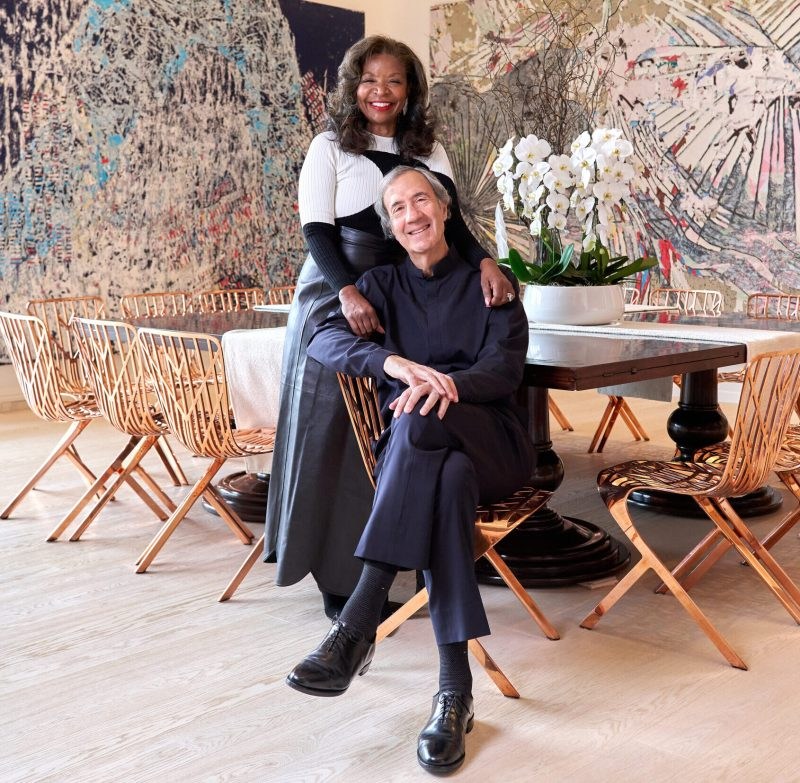
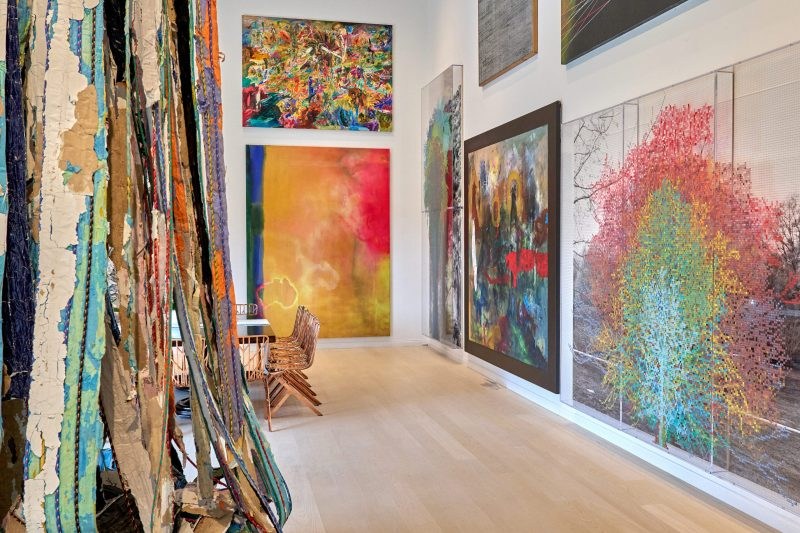
At Lake Tahoe, in Reno, Nevada, the house was designed to hold the collection. Art covers nearly every inch of wall, and in one case it tumbles from the ceiling. Mark Bradford’s A Private Stranger Thinking About His Needs (2016) is one of the very few waterfall sculptures he has made, twenty-five feet tall, and she names it the most challenging piece she has acquired. They made a specific place for it, and she says they love living with it. On a domed ceiling twenty feet high sits Leonardo Drew’s 129S, one of his explosion pieces, which she compares to a chapel with a twist.
Around them hang Frank Bowling’s Samson’s Arrival (1989–90), Norman Lewis’s Afternoon (1969), Jack Whitten’s Zen Master (1968) and Melvin Edwards’s Words of Fanon (1992). She and Giuffrida hang art in dense arrangements that she jokes can shock visitors. One of her most recent purchases is a painting by Sydney Cain, in which she saw a palpable sense of spirituality.
By 2021 the collection numbered more than 300 works, and the couple chose to work with existing institutions rather than open a private museum. That March SFMOMA announced a gift of 31 paintings, sculptures and drawings by 20 artists, among them Elizabeth Catlett, Beauford Delaney, Norman Lewis and Richard Mayhew. Joyner, an SFMOMA trustee since January 2020, worked with the curator Gary Garrels to choose pieces that fill historical gaps. “This group of artists was written out of mid-century modernist history only because they were Black,” she said. The museum says the gift prompted a reexamination of its permanent collection, and that a third of it had hung through its galleries since fall 2020, with a rotating installation devoted to Mayhew.
Her vision kept widening. Joyner added Brazilian artists, because most of the transatlantic slave trade went through Brazil, which has the largest Black population outside Africa. She has collected Sonia Gomes, Tadáskía and Ana Cláudia Almeida, she attends the São Paulo Bienal, and she helps fund publications so that artists remain in the art-historical record long after their exhibitions close.
She works inside institutions as well as around them. She chairs MoMA’s Painting and Sculpture Committee, sits on acquisition teams at MoMA and SFMOMA, and in 2020 co-founded the Black Trustee Alliance to foster the next generation of Black art patrons and leaders. The Pérez Art Museum Miami describes her collecting positions as often taken with specific museums in mind, and her support for curators and scholars who diversify the field. In 2014 she and Giuffrida began an artist residency in Sonoma, and in 2021 they moved it to the Nevada Museum of Art. Artists stay three months and spend them as they choose, and each is offered the chance to show work at the museum. She has sometimes bought what they made, among them a painting by Thomas J. Price, which she called an honor to receive from the residency.
She began with empty walls. Her advice to a new collector is to see a lot of art, to buy books before buying much, and to have an area of focus, and she says collecting makes you a lifelong learner. By Artsy’s count in 2025 the collection she shares with Giuffrida numbers around 600 works, and she keeps looking for ways to put it to use in the art ecosystem and in new art histories.
Collection economics
Around 600 artworks, jointly collected with Alfred Giuffrida, reported in 2025.
A 2021 SFMOMA gift comprised 31 works by 20 artists.
Evaluate the coherence of a collection alongside the quality and price of each work. The editorial lesson: scholarship and public access are meaningful outcomes, separate from resale performance.
Pamela’s 10 collecting tips:
Adapted from public interviews
Collect with a purpose
Join Neoclassical Pop Art daily take on the arts, the weekly letter, and first word on product launches, sales, and free gifts.