
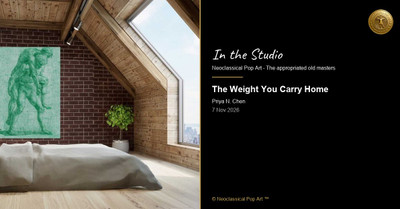
The Weight You Carry Home
Priya N. Chen on 7th Nov 2026
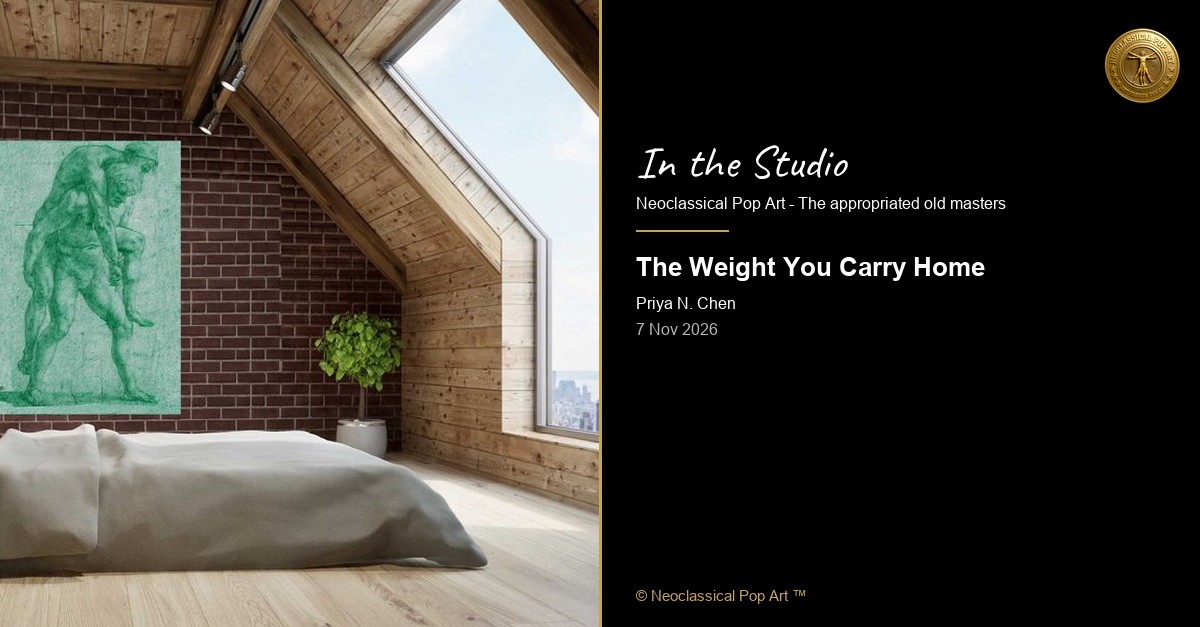

The Weight You Carry Home
A young man bends under the weight of an old man on his back, and the old man holds on. Around 1514 Raphael drew the pair in red chalk, a study now in the Albertina in Vienna (inv. 4881). It is not a portrait and not a saint. It is two figures and a single act, and nothing else is needed.

A boy from Urbino, a painter in Rome
Raphael was born in 1483 in Urbino, a small, highly cultured court city where his father, Giovanni Santi, was court painter to the duke. His father died when he was eleven, and the boy seems to have helped run the family workshop from then on. By 1500 he was called a fully trained master. A few years in Florence from about 1504 brought the influence of Leonardo da Vinci, and in 1508 Pope Julius II called him to Rome, where he stayed.
The drawing belongs to the busiest stretch of that life. In Rome he painted the Vatican rooms that carry his name, beginning with the School of Athens. In 1514 Bramante died and Raphael was named architect of the new St Peter's. He ran an unusually large workshop to meet the demands of two popes, Julius II and then Leo X, and he died in 1520, aged thirty-seven.
A study for a fire
The drawing is a study for the group painted in the lower left foreground of The Fire in the Borgo, in the Stanza dell'Incendio, painted between 1514 and 1517. The fresco shows Pope Leo IV halting a fire in the year 847 with a blessing from a balcony in front of Old St Peter's. Raphael is credited with the design of the composition, though some critics believe the fresco was most probably painted by his assistant Giulio Romano.
Away from the miracle, a young man carries his father out of the flames. Vasari, writing in 1550, read that group as Virgil's Aeneas carrying Anchises out of burning Troy, and the reading has stayed with the picture.
The man on his back
The story is from Virgil's Aeneid, the Latin epic written between 29 and 19 BC. Troy has fallen: the Greeks, who pretended to sail away, have come out of the wooden horse and opened the gates. The dead Hector appears to Aeneas in a dream and tells him to flee with his family. Aeneas escapes with his son Ascanius, his wife Creusa and his father, Anchises, who is too old to walk, and he carries his father on his back toward the mountains.
At the city gate they find Creusa missing. Aeneas goes back into the burning city to look for her and finds only her ghost, who tells him that his road leads to a new kingdom. Rome called the quality at the heart of this scene pietas, the duty owed to family, gods and homeland. In the legend, the man who leaves Troy with his father on his back founds the line that leads to Romulus and Remus.
Raphael's hand, and what followed
Raphael is admired for the clarity of his forms and the ease of his compositions, which gave the Neoplatonic ideal of human grandeur a visible shape. With Leonardo and Michelangelo he forms the traditional trinity of the High Renaissance. His friend Castiglione named the quality his work aims at: sprezzatura, a nonchalance that hides all artistry. Much of his later work was carried out by his workshop from his drawings, which is why the drawings matter: they hold the design before anyone else touched it.
Outside Rome his work was known mostly through the prints made from it. After his death Michelangelo's influence outweighed his until the eighteenth and nineteenth centuries, when Raphael's serene, harmonious qualities were again held up as the highest models. Winckelmann made him a formative influence on Neoclassical painting, and the Pre-Raphaelite Brotherhood later rejected his methods outright. Few painters have been a model and a target for so long.
Unconditional Love
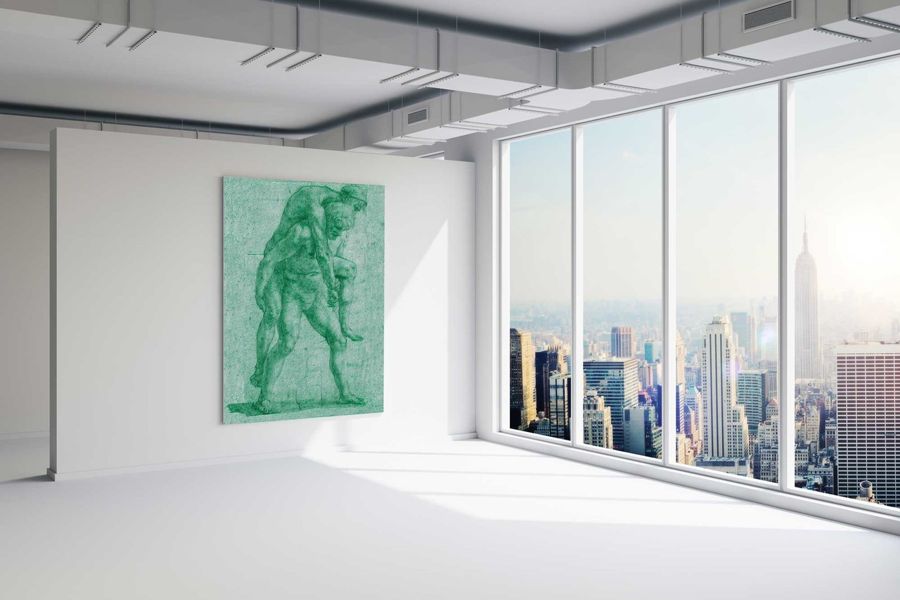
Neoclassical Pop Art takes that study and gives it colour. "Unconditional Love" is a hand-painted oil on stretched canvas that keeps Raphael's pair and gives them a single green. Green is a decision in a room: it sits between the cool of stone and the warmth of wood, and it makes both look better.
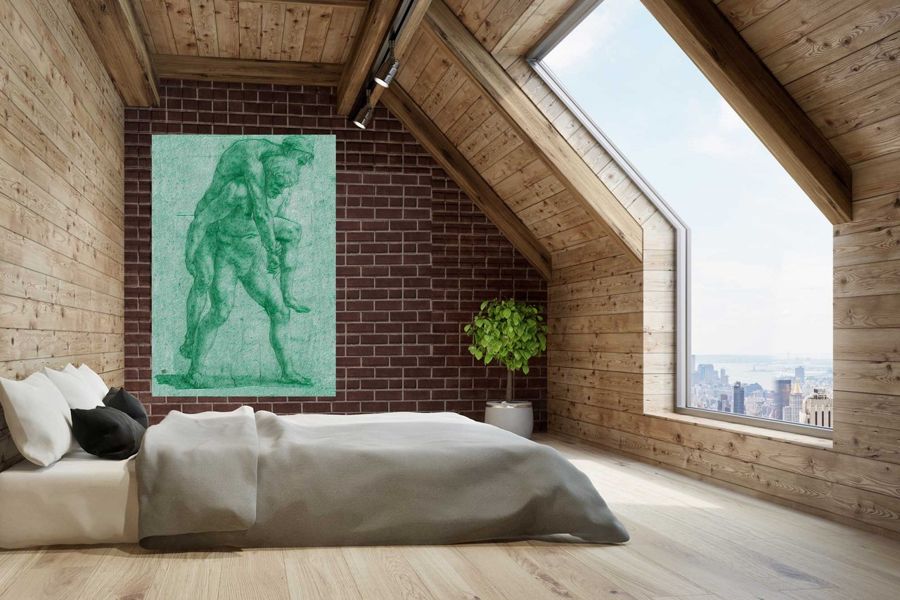
The same drawing is painted in orange, in pink and in light blue, each a different mood from the same gesture: heat, tenderness, calm. Choose by the room, not by the sofa. Interior designers speak of a focal wall as the place where a house tells you what it values, and few subjects say it as plainly as this one: a quiet reminder of who carries whom.
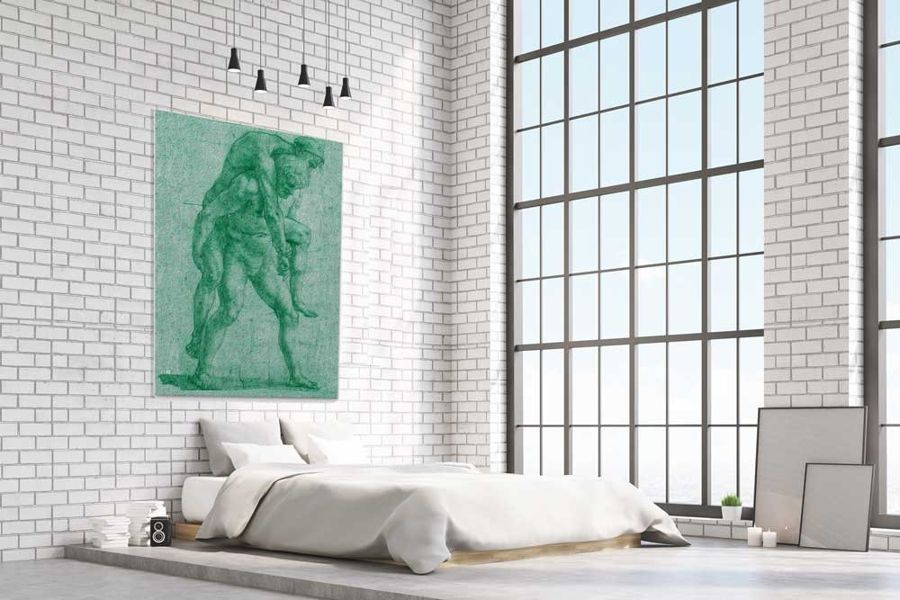
Hung where the family gathers, it puts a picture of family above the table.
Carry the Weight Home
"Unconditional Love" belongs to the Limited Edition collection, a limited edition of five. Each canvas is hand-painted in oil on stretched canvas and made to order, and it ships within forty days. Five is the whole edition, so it will not come round again.
Raphael drew a son carrying his father so that a painter could put him in a fresco. The studio paints him so that you can carry him home.
Carry it home.
Join Neoclassical Pop Art daily take on the arts, the weekly letter, and first word on product launches, sales, and free gifts.