
A Grey Ground and a Straight Back
Priya N. Chen on 31st Oct 2026
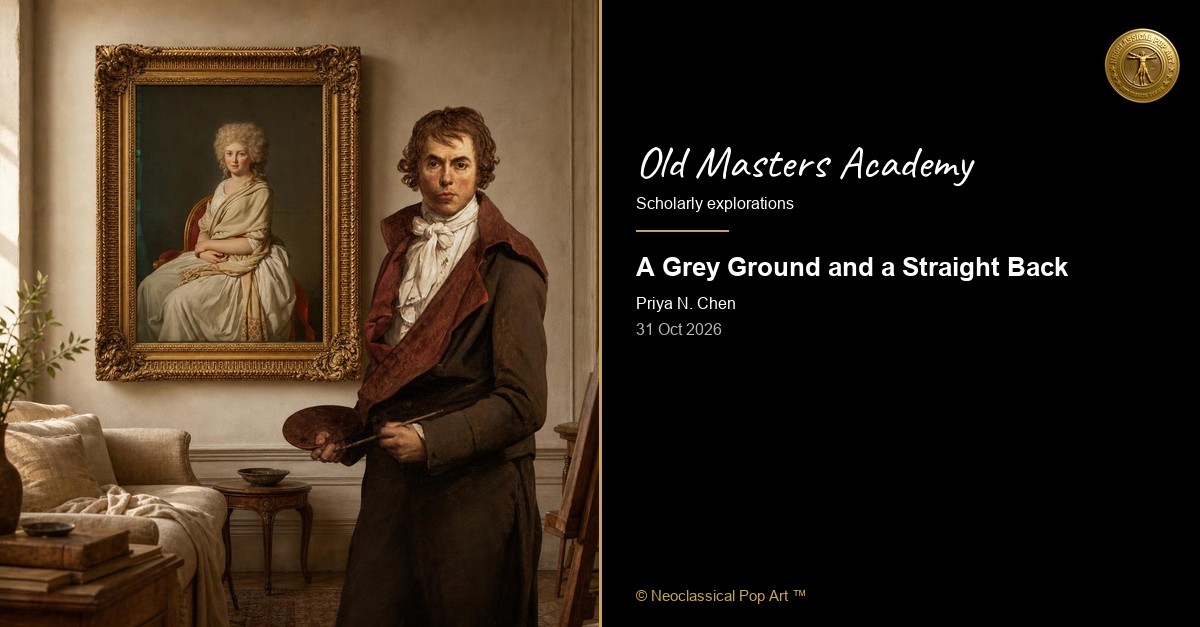

A Grey Ground and a Straight Back
Neoclassicism emerged around 1750 as a particularly pure form of classicism—an art that turns back to ancient Greek and Roman style. As the Tate's account notes, the unearthing of the Roman ruins at Pompeii and the publication in 1764 of Johann Joachim Winckelmann's history of ancient art set off an intense eighteenth-century flourishing across painting, sculpture, architecture, and design. Jacques-Louis David's 1790 portrait of Anne-Marie-Louise Thélusson, Comtesse de Sorcy, belongs to that turn. Its stillness is not an afternoon's studio whim; it is the discipline of a movement.
In France, the leading painter of that movement was Jacques-Louis David (1748–1825). Born in Paris, he trained under the classicising painter Marie-Joseph Vien before spending the years 1775 to 1780 in Rome, and returning to Italy in 1784 to 1785. Elected to the Académie Royale in 1783, he won his name in the 1780s through history paintings of severe design and theme—above all The Oath of the Horatii of 1785, now in the Louvre—while building a parallel reputation for portraits. As the Louvre's commentary on the Sorcy canvas observes, David was first a history painter; portraiture supplied a steady income and a clientele drawn largely from the liberal Paris haute bourgeoisie. When the Revolution broke out in 1789, he took an active part. The National Gallery in London notes that he became a deputy to the new parliament and helped abolish the Royal Academy of Painting and Sculpture, without assigning those two acts to 1790; this study keeps them out of the sitting room.
The portrait is dated 1790, one year into the Revolution. What the historical record allows us to bring to the easel in that year is a Roman formation, a history painter's habit of austere design, a working portrait practice, and a political commitment already begun. One reading is that the bare ground and the unyielding spine carry the severity of David's history pictures into a domestic marriage commission. The notes do not settle whether David intended that equation. Later chapters of his life recorded by the National Gallery—imprisonment in 1794 to 1795, the ceremonial canvases for Napoleon, and exile in Brussels after 1815—belong to the years ahead and cannot be read backward into 1790.
Before the canvas itself, the eye meets a figure seated upright, her hands folded quietly in her lap. A white gown occupies the lower half of the rectangle. A pale shawl crosses the bodice and falls with a narrow patterned border. Red upholstery appears twice: at the curve of the chair back by her shoulder, and beside the fall of the skirt. Behind her spreads an unbroken grey-green field—no pilaster, no casement, no book or fan between the fingers. The Munich reproduction includes a later gilt frame; the painting under study is the quiet field inside it.

Even before the sitter is named, the architecture of the surface holds. The white dress is the largest mass; the grey ground is the widest interval; the red chair is a measured accent; the clasped hands are the small hinge where the composition comes to rest. Tested against Clive Bell's question—whether form and interval hold on their own before narrative begins—one reading is that the picture locks into place by weight and proportion alone. Sister Wendy Beckett's question turns toward the viewer's encounter with the sitter: the face looks directly out, the lips remain closed, and the spine refuses to yield to the chair. The gaze is at once candid and withheld.
John Ruskin's question asks what the eye has truly observed in the cloth, as opposed to a studio formula for dress. Here the muslin falls in long, unforced folds rather than springing outward over a frame. The Neue Pinakothek record notes that neither corset nor hoop is worn, and describes a partly visible orange sash. The Louvre's exhibition text for the same work names a white dress, a cream shawl, and the red of the armchair and belt. Because the two museum texts use different color words for that warm waist accent, this study leaves the discrepancy open rather than inventing a pigment name. What both records and the canvas confirm is the severity of the palette: white and cream set against a cool grey-green, warmed only by a narrow measure of red.
Format is where the formal break becomes historical. In the Neue Pinakothek catalogue, this canvas is identified as David's first Kniestück—his first knee-length portrait—and the moment he strips away the customary apparatus of room and costume. Cut just below the knee, the body stands close to the picture plane. Following Alfred H. Barr, Jr.'s way of defining a work by the structural choice that inaugurates a type, that cut and the emptied room establish the model. The Munich record calls the grey ground in an armchair the truly revolutionary element of the painting, noting M. Bleyl's term ästhetisches frottis for the rubbed, vibrating scumble that became a hallmark of David's portraiture. Bleyl's book was not opened for this study; the museum's statement is what stands: the innovation lies in the brushed ground itself.
Kenneth Clark's question asks what older poise survives inside a new style. The Louvre describes Madame Thélusson's carriage as slightly distant and hieratic, seated straight and facing the spectator, and characterizes the paired portraits as an alliance of rigor and nobility. No antique column or relief is needed to announce classicism; the rectitude of the posture carries it. The carved crest and red cushion of the chair fix the figure in space, while the resting hands refuse any rhetorical gesture beyond the frame.
In curatorial terms, the work is oil on canvas, 129 by 97 centimetres, dated 1790, held at the Bayerische Staatsgemäldesammlungen—Neue Pinakothek in Munich (inv. HUW 21) as a permanent loan from HypoVereinsbank, and currently not on view. Charles Baudelaire's question asks how the stamp of a specific year enters a portrait. The Munich record points to the dress and hair: worn natural, freed from corset and hoop, the costume already speaks the language of 1789 and 1790. One reading is that the historical pressure of 1790 registers in that uncorseted line and in the scumbled grey wall—without a single tricolour ribbon or political emblem added for show.
Filippo Baldinucci's habit of inquiry begins with the commission and the household that ordered it. Both this canvas and the pendant of the sitter's sister Robertine were commissioned to mark their marriages: Anne-Marie-Louise Rilliet to Jean-Isaac Thélusson, Comte de Sorcy, and Jeanne-Robertine Rilliet to Jean-Louis Tourteau d'Orvilliers. As the Munich record details, the bride came from the wealthy Genevan Protestant banking house of Rilliet in Paris; in 1787, at seventeen, she wed Thélusson, heir to another Swiss banking family who had entered military service. The Thélussons had previously patronized Hyacinthe Rigaud and Jean-Étienne Liotard, and commissioned Claude-Nicolas Ledoux to build their Parisian hôtel. Only since 1782 had Protestant families in France been permitted to purchase landed estates and bear the noble titles attached to them.
Tested by the questions of Linda Nochlin and Lucy Lippard—who is placed before the brush, who holds it, and which social institutions govern the exchange—the woman in white is the subject of a dynastic marriage contract, bearing a countess's title her husband's family had been legally able to hold for scarcely eight years. Lawrence Alloway's question traces the wider network the object enters: a Protestant banking house accustomed to Rigaud, Liotard, and Ledoux now turns to David, whose portrait practice rested on the liberal Paris bourgeoisie.
The pendant in the Louvre—Jeanne-Robertine Rilliet, Marquise d'Orvilliers (inv. RF 2418), also painted in 1790—sharpens the reading by contrast. Commissioned as a pair, the two sisters inhabit the same format with opposite degrees of reserve. Where the Comtesse de Sorcy sits upright and slightly remote, the Louvre notes that her sister crosses her legs and rests an elbow on the chair back with greater ease.

In the Louvre canvas, that ease is built from a black gown, a broad white fichu, a red waist sash, and a red ribbon threaded through the hair, one forearm laid along the crest of the chair while the hands remain quietly joined. Signed and dated L. David 1790 at the lower left, the portrait shares the same knee-length cut and the same scumbled grey-green field. Identical means yield two distinct temperatures of self-possession.
What the opened records sustain is a precise conclusion. In 1790, the foremost painter of French Neoclassicism answered a marriage commission from a newly titled Protestant banking family by clearing the salon away, cropping the figure below the knee, and setting two sisters against a bare, vibrating grey ground. One reading is that this refusal of aristocratic props gives visual form to a class and a year in transition. The notes do not settle David's private intention; they establish the ground he painted.
Looking exercise. Hold one hand over the sitter's face, then move it to cover the red of the armchair. Ask which loss disturbs the balance of the rectangle more. When the white mass of the dress and the grey interval of the wall still hold the surface together, the architecture of the painting is doing the work before expression begins. Uncover the face and observe how much the straight back and closed mouth keep to themselves.
Resources: Bayerische Staatsgemäldesammlungen, Neue Pinakothek, "Anne-Marie-Louise Thélusson, Comtesse de Sorcy," 1790, oil on canvas, 129 × 97 cm, inv. HUW 21 (updated 9 Oct 2026) · Musée du Louvre, "Une alliance de rigueur et de noblesse" · Wikimedia Commons, Comtesse de Sorcy (photo by Szilas, public domain) · Wikimedia Commons, Marquise d'Orvilliers, Louvre RF 2418 (photo by Shonagon, 2022, public domain) · Tate, "Neoclassicism" · National Gallery, London, "Jacques-Louis David, 1748–1825" · Wikimedia Commons, Self-Portrait, 1794, Louvre (public domain). Not opened: M. Bleyl ("ästhetisches frottis" cited via the Munich record), and no books by Alloway, Baldinucci, Barr, Baudelaire, Beckett, Bell, Clark, Lippard, Nochlin, Ruskin, Rosenberg, Williams, Fuchs, Koschatzky, Ólafsdóttir, R. C. Smith, Cahill, Fellman, or T. J. Clark.
Join Neoclassical Pop Art daily take on the arts, the weekly letter, and first word on product launches, sales, and free gifts.