
Measure & Interface: Leonardo's Vitruvian Man
P. N. Chen on 8th Oct 2026

There are drawings that refuse to stay in the notebook. Leonardo da Vinci’s Vitruvian Man - metalpoint, pen and ink, with touches of watercolor on a sheet scarcely larger than letter paper, now held by the Gallerie dell’Accademia in Venice - does not hang politely in the imagination. A nude figure stands in two poses at once. Arms reach a square; limbs open into a circle. Notes in mirror writing frame the body like a silent interface. You do not so much admire him as feel measured by him.
That is the old power of proportion: the body treated as a system that can be known. And it is, uncannily, the new power of the screen - the surface that maps us into grids, metrics, and models until something in us feels already calculated.
The sheet that measures back
Leonardo did not invent the problem. He reinvented the diagram. Around 1490, in Milan, he set out to visualize a passage from Vitruvius - the Roman architect and engineer whose De architectura (often called the Ten Books on Architecture) is the only substantial architectural treatise to survive from antiquity. In Book III, Vitruvius describes how an ideal human figure can yield both a circle (centered on the navel when limbs are extended) and a square (because height equals the span of the outstretched arms). He offered no illustration. Renaissance artists had to invent one.
Leonardo’s solution is elegant and empirical. He doubles the limbs: one stance fits the square, another the circle. He offsets the two geometries so the navel centers the circle while the square is centered lower, near the genitals - a correction that lets the figure remain anatomically convincing without forcing the limbs. The Accademia still catalogs the sheet as a study of the proportions of the human body known as the Vitruvian Man. The popular nickname is newer; Leonardo’s own framing is measurement first.
Vitruvius, geometry, and the technology of measurement
Marcus Vitruvius Pollio wrote in the age of Augustus. His treatise argues that temples should show harmony among parts and whole, and he turns to the body as the clearest available model of that harmony. Four fingers make a palm; four palms a foot; the outspread arms equal the height. Architecture, in this view, is not decoration layered onto structure. It is proportion made inhabitable.
Leonardo’s sheet belongs to a longer Renaissance effort to make that text visible. Francesco di Giorgio Martini produced early Vitruvian-figure studies in the later fifteenth century. Around 1490, Leonardo’s friend and fellow Vitruvius reader Giacomo Andrea da Ferrara worked a related figure inside circle and square - a drawing scholars rediscovered only in recent decades, and which suggests conversation rather than solitary genius. Leonardo’s notes also show him testing classical claims against observation and against Leon Battista Alberti’s proportional thinking. The Accademia notes that the numbers sit closer to Alberti than to Vitruvius. Vitruvius gives the foot as one sixth of the height; Leonardo writes one seventh. Whether that seventh is his choice or a fault in the manuscript he used is still disputed. The famous image is less a logo of "Renaissance man" than a working interface between text, body, and geometry.
The geometry itself brushes an old mathematical dream: squaring the circle - relating those two perfect figures without distortion. Leonardo does not solve the classical impossibility; he stages a practical reconciliation. By shifting centers and doubling poses, he lets one body argue for both cosmic circle and earthly square. The notes around the figure, written in his characteristic mirror script, from right to left, list fractional measures from hairline to foot. Measurement here is not metaphor. It is method.
Ideal, not average - and not the golden ratio
Readers today often ask whether the proportions are "accurate," and whether the golden ratio secretly governs the page. The drawing is an ideal, not a population mean: Leonardo fused Vitruvian rules with his own measuring campaigns among living models. A 2020 scan of young U.S. Air Force recruits found many of his listed ratios within about ten percent for the men. Arm span and thigh length diverged further. The sample is not his, and the drawing was never a population average. As for the golden ratio, the claim is largely a later myth. Analyses of the circle-to-square relationship do not require phi; Vitruvius’s own passage concerns navel, arm span, and simple fractions, not a golden rectangle. Leonardo likely drew the sheet before his documented collaboration with Luca Pacioli on divine proportion.
Nor is the figure a known named portrait. No secure identity survives for a single "model." What survives is a measured type - a body treated as a readable system.
The modern screen as a new measuring surface
Here is where the late fifteenth century leans into the twenty-first without needing a lecture.
We live inside portable measuring rooms. Phones, laptops, fitness trackers, cameras, recommendation engines: surfaces that promise to show us the world while quietly mapping us into data. Posture becomes a heatmap. Face becomes a login. Attention becomes a metric. The feed is a proportion machine with infinite limbs. Look too long, too straight, too hungry for confirmation, and something softens into profile - the self hardening around its own numbers.
Leonardo’s insight, read through a contemporary lens, is not "data is bad." It is subtler, and more useful: the danger is unexamined measure. The ideal body becomes tyranny when it forgets it is a model. The screen becomes clarifying when it remains an angled instrument rather than a verdict. In that sense the drawing rhymes with another Neoclassical Pop Art meditation on surfaces that look back - the essay on Caravaggio’s Medusa and screen culture, where the problem is the gaze that seizes. Here the problem is the grid that claims to know us.
The image’s afterlife already proves how readily a measurement diagram becomes cultural currency. Italy’s €1 coin carries Leonardo’s figure as a national emblem of proportion and humanism. In 2019, after a contested loan dispute and a Venice court ruling, the fragile sheet traveled briefly to the Louvre for the quincentenary of Leonardo’s death - then returned to conservation darkness. Because light damages works on paper, the Accademia shows the original only rarely. Most of us meet him as a reproduction: a public-domain ghost circulating through classrooms, logos, and timelines. That circulation is itself an interface history.
Other hands on the same sentence
Vitruvius wrote the rule and left the page blank. Other hands tried to draw it. Leonardo’s sheet is the famous answer. It is not the only one.

Francesco di Giorgio Martini draws the man as a church. The head sits under the pediment. The arms are the width of the walls. Vitruvius had said a temple needs the correspondence of a well-formed body. Here the body is the temple, ruled into courses of stone. You can see the building thinking with a person inside it.

His other sheet steps closer to the picture we know. One pose. A circle and a square. The centers are still shared. The limbs are not doubled. Leonardo’s sheet separates the two centers. This one still shares them.

Mariano Taccola, the Sienese engineer, treats the man as an instrument. A compass hangs over the head. Circles pass through the torso. The body is a machine for taking a measure. That is an engineer’s Vitruvius: less a nude, more a diagram you could build from.

Giacomo Andrea, in Milan with Leonardo, keeps the circle and the square and writes the ratios beside the figure. One stance. Pacioli later called him Leonardo’s brother in friendship. The two drawings are close. Whether they worked the picture together is still an argument, not a record.

In 1511 Fra Giovanni Giocondo printed Vitruvius in Venice and gave the text two pictures, on facing pages: a man in a circle, and a man in a square. He did not join them in one body. The book could finally show what the sentence had only described.


These printed pages are sometimes captioned as Vitruvius. He did not draw them. Printers did, long after the sentence. The words stayed. The picture kept being invented.

Dürer carries the same hunger into a craftsman’s table. An arm lifts. The body is divided into numbered parts. A smaller figure at the corner repeats the gesture. Measurement leaves the ideal nude and becomes a method you can follow with a ruler.
Contemporary response - Neoclassical Pop Art and the measured body
The contemporary works reproduced here are part of PriYa N. Chen’s ongoing Neoclassical Pop Art series, which reinterprets classical imagery through contemporary material and digital culture. Classics meet code once more: the Vitruvian diagram returns as color, acrylic glow, and room-scale presence - not as a museum footnote, but as a question hung where we live and work. Who is measuring, and who is being modeled?

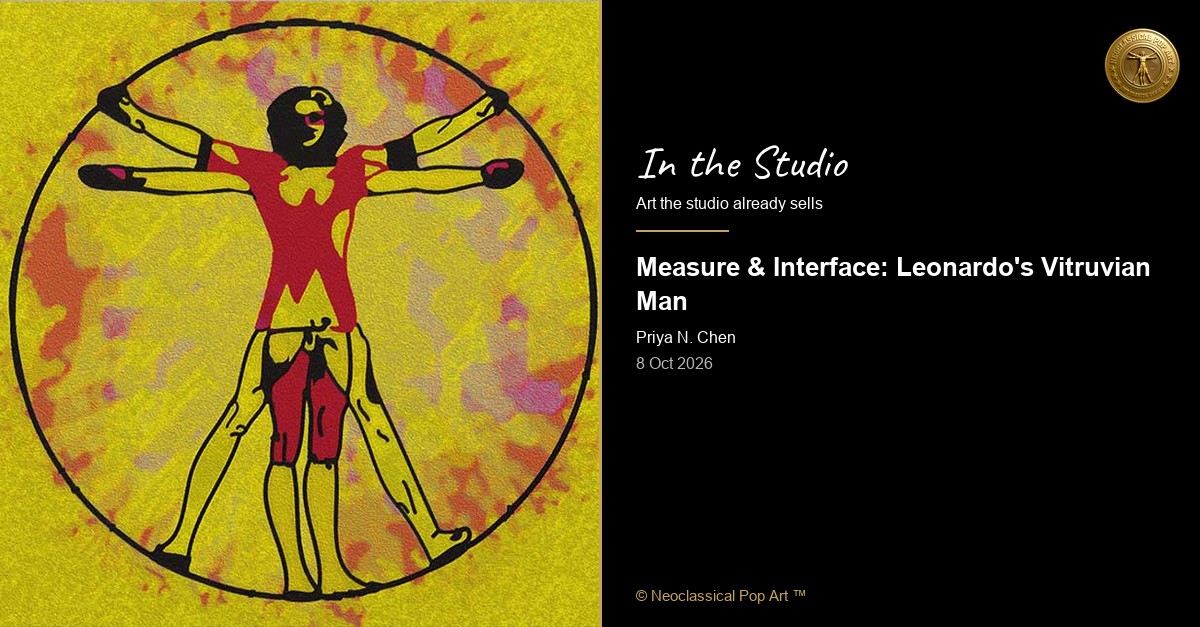
In the large oil edition, the classical silhouette is restated in saturated yellow, red, and black - the Renaissance outline kept, the palette flipped into Pop chroma. The circle still organizes the figure; the room around the canvas becomes the new square of daily life. Proportion leaves the notebook and takes the wall.

In the blue acrylic works, the historical sheet is translated into another reflective contemporary surface. Cool luminosity places the measured body closer to the visual language of screens, glass, and illuminated interfaces. Printed on acrylic, the image acquires a depth that recalls the display while answering it with an object whose material presence resists the weightlessness of the feed.
Holding the measure without becoming the metric
We do not need to abandon measurement. We need Leonardo’s craft and Vitruvius’s caution: ratios in service of harmony, not captivity. An angled seeing that can read a model without surrendering the self to it.
In an age of endless dashboards, that is less a museum footnote than a daily practice.
The compass is yours to hold.
FAQ
What is Leonardo’s Vitruvian Man?
It is a c. 1490 drawing in metalpoint, pen and ink, with touches of watercolor, on paper showing a nude male figure in two overlapping poses, inscribed in a circle and a square. Leonardo made it as a study of ideal human proportions inspired by Vitruvius. The sheet belongs to the Gallerie dell’Accademia in Venice.
Who was Vitruvius, and what did he write about the body?
Vitruvius was a Roman architect and engineer of the late Republic and early Empire. In De architectura, Book III, he argues that architectural harmony should mirror the proportions of the human body, describing how a figure can yield both a circle centered on the navel and a square whose side equals the arm span. He left no drawing of that idea.
Why did Leonardo create the drawing?
Around 1490 in Milan, Leonardo sought to visualize Vitruvius’s unillustrated description while checking it against his own measurements and contemporary theory, including Alberti. The sheet functions as diagram, notebook page, and argument that the body can mediate between earthly square and cosmic circle. It does not appear to have been a public commission.
Does the Vitruvian Man use the golden ratio?
Popular accounts often claim it does, but the claim is weakly supported. Vitruvius’s passage concerns simple body fractions, navel, and arm span; geometric studies of Leonardo’s circle and square do not require phi. Leonardo likely drew the sheet before his later work with Luca Pacioli on divine proportion.
Can you see the original in person?
Rarely. Because prolonged light damages works on paper, the Accademia keeps the drawing in protected storage and exhibits it only occasionally. It was loaned briefly to the Louvre in 2019 after an Italian court cleared a contested loan for Leonardo’s 500th-anniversary exhibition, then returned to Venice.
Are the proportions accurate for real bodies today?
They describe an ideal system, not an average person, and no named model is securely identified. A 2020 scan of young U.S. Air Force recruits found many of Leonardo’s listed ratios within about ten percent for the men. Arm span and thigh length diverged further. The sample is not his, and the drawing was never a population average.
Works from the Da Vinci Series
Explore the contemporary works discussed in this essay.